The tenant reports it before maintenance does
A ceiling tile below the rooftop unit darkens, then sags, then drips. In most buildings the first report comes from whoever sits under it rather than from the maintenance team, which means the water has already been running for a while by the time anyone with a ladder hears about it.
There is usually a second complaint alongside it, logged separately: that unit has stopped cooling. Those two tickets get assigned as two problems. They are almost always one.
What is actually happening
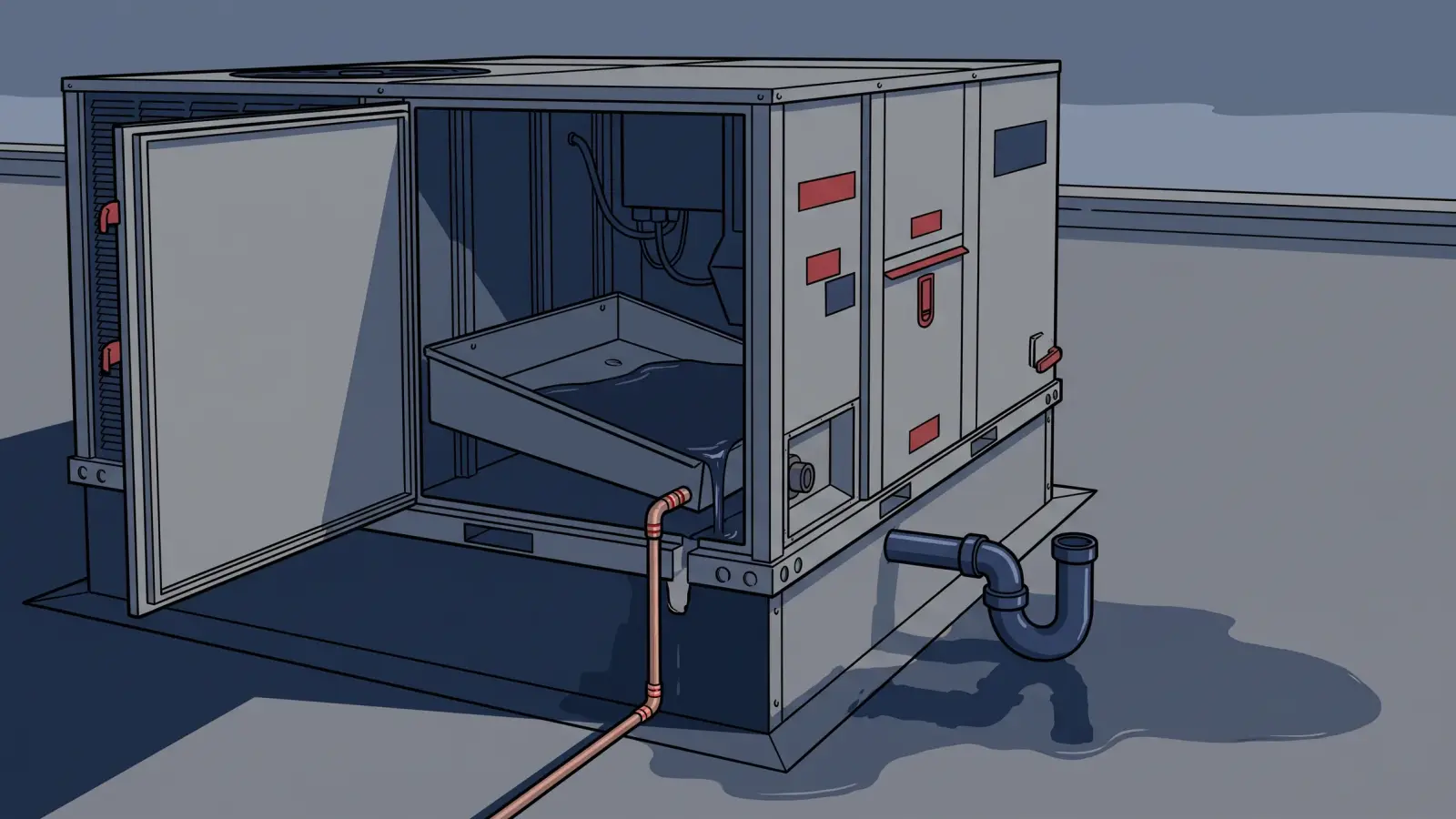
The condensate drain has blocked and the pan has overflowed. On equipment that monitors the pan, the loss of cooling is not a coincidence: it is the control deliberately stopping the unit from making any more water.
And there is a second cause that survives a drain cleaning, which is the reason this fault comes back. Because the drain connection on a packaged rooftop sits on the suction side of the fan, a trap is not optional. Trane states it plainly: "A condensate trap must be installed at the unit due to the drain connection being on the 'negative pressure' side of the fan" 3. Without a correctly formed trap, fan suction holds water in the pan against gravity, and the pan fills while the drain line sits perfectly clear.
The same literature names the failure that fools experienced technicians. Trane specifies pitching the drain line "at least 1/2 inch for every 10 feet of horizontal run" and warns against letting the run sag, "causing a possible double-trap condition which could result in condensate backup due to 'air lock'" 3. A sagging line holds a second water seal. Air cannot pass, condensate cannot move, and the pan overflows — a week after somebody proved the drain was clear by pouring water down it.
A trap built wrong is more common in the field than a trap left out, and the depth is the part that gets missed. The seal has to be sized to the static pressure the fan pulls against it; built to the wrong depth it fails exactly the way a sagging line or a missing vent fails. What follows from that is poor drainage rather than an outright stoppage, and poor drainage is what lets material build up inside the line over the following seasons until the blockage everyone blames arrives on its own.
So the diagnostic question is not only "is the drain blocked." It is "is there a trap, is it the right shape, and does the line downstream of it run downhill the whole way."
What this looks like across equipment lines
York. The SunPremier control carries fault 188, "Cooling locked out - condensate overflow", with the stated cause "Condensate drain is clogged" 2. It is a critical lockout: the unit stops cooling so it stops producing condensate. This is why the leak ticket and the no-cooling ticket are the same fault, and why closing one without reading the other wastes a visit.
Trane. The optional Condensate Overflow Switch on the drain pan, read through the ReliaTel Options Module, behaves differently in a way facility managers feel directly. "When the condensate level reaches the trip point for 6 continuous seconds, the RTOM will shut down all unit functions until the overflow condition has cleared," returning to normal after six continuous seconds untripped 3. York locks out cooling; Trane stops the entire unit. So the call that comes in is "the rooftop is dead," not "the rooftop will not cool," and the water gets mentioned second if at all.
Trane then adds a repeat counter: "If the condensate level causes unit shutdown more than 2 times in a 3 days period, the unit will be locked-out of operation requiring manual reset." And a detail worth knowing before you trust a fault history: "cycling unit power will also clear the fault" 3. A reset erases the pattern along with the fault.
That is not usually somebody covering their tracks, though. Site staff rarely know why the unit shut down in the first place, so the ticket that reaches us is a no-cooling call, and the drain turns out to be the cause once somebody diagnoses it. The water and the dead rooftop arrive as two unrelated complaints from people who have no reason to connect them, which is the reason to read them together at intake rather than to expect the site to have done it.
From the roofing side, condensate is treated as a roof risk in its own right rather than as a mechanical nuisance. Facility guidance advises confirming annually that condensate lines and their discharge "do not create moisture problems" 4, which is a different question from whether the drain flows, and one no mechanical service call asks.
The diagnostic path
- Read the fault history before treating the leak and the cooling complaint separately. One overflow fault explains both symptoms 2.
- Ask whether the unit has been power-cycled, without treating it as evasion. On Trane equipment a reset clears the fault and erases the pattern 3. Site staff generally do not know what they cleared, so the answer is information about the fault history, not about the site. If it has been reset, the fault is older than the ticket.
- Clear and verify the primary drain, then verify the trap exists, is correctly formed, and is the right depth for the static pressure. A trap is mandatory on a negative-pressure drain connection, and one that is missing, mis-built, or too shallow produces overflow with a completely clear line 3. Wrong depth is the common version of this and it presents as poor drainage rather than as a stoppage, so it is the one that comes back.
- Sight the entire horizontal run for sag. This is the step that stops the fault recurring. Trane's stated minimum pitch is half an inch per ten feet 3; a dip anywhere in the run can hold a second seal and air-lock the line.
- Confirm pan slope and that the secondary or overflow provision is intact.
- Look at where the condensate discharges onto the roof. A drain that flows perfectly and discharges into a seam or a low spot is still a building problem 4.
Steps 3, 4 and 6 are the ones that separate a repair from a return visit. Step 1 is the one that saves a whole truck roll.
Repair or replace
Repair. Clearing a drain, forming a trap correctly, or re-pitching a run are all small mechanical work relative to the unit.
The judgement that matters is upstream of the equipment. Repeated overflow does not only wet ceiling tiles: it can damage the pan, the curb and the roof assembly beneath the unit, at which point a small mechanical repair has become a building envelope conversation, and the question of who owns the damage arrives with it. Any figures raised in that conversation are directional until the curb and the deck have been opened and looked at.
What a maintenance program catches first
Drain clearing is among the most routine tasks in any rooftop maintenance scope and among the most expensive to skip, because the cost of skipping it does not land on the equipment. It lands on ceilings, floor finishes, stock, and tenant relationships — none of which appear in a mechanical budget, and all of which are more expensive than the visit that would have prevented them.
A scope worth paying for does four things a reactive call does not: it clears and proves the drain before cooling season rather than during it, it inspects the trap and the pitch of the run rather than only the pan, it checks where the water goes once it leaves the unit, and it documents the condition of the drain, trap and run, so the next visit starts from a record.
Related: what a preventive maintenance program catches first
Working in the Bay Area
Monzo HVAC has serviced Bay Area commercial and industrial rooftop equipment for thirty years, on buildings where the tenant under the stain and the owner responsible for the roof are frequently not the same party. That is worth naming, because the mechanical fix here is usually straightforward and the conversation around it usually is not.
If a ceiling is staining under a rooftop unit at your facility, call Monzo HVAC at (925) 536-0535 to discuss your commercial HVAC service needs or arrange an evaluation.
Ask about our Health, Performance & Safety Plan: a performance baseline for every unit, operating data logged at every maintenance visit, and the safety checks that help identify developing issues early, scoped to a budget you set.
Service: commercial HVAC maintenance programs
Frequently asked questions
Why did the unit stop cooling when the problem is a leak?
We cleared the drain and it happened again. Why?
Most likely the trap or the pitch, not the blockage. A missing trap lets fan suction hold water in the pan, and a sagging horizontal run creates a double-trap air lock that stops flow entirely 3. Both produce overflow with a drain line that tests clear.
Someone reset the unit and it started working. Is it fixed?
No. On Trane equipment, cycling unit power clears the overflow fault outright 3. The water condition that caused it has not changed, the repeat counter has been reset, and the next indication will be the ceiling rather than the control.
Is the water damaging the roof as well as the ceiling?
Possibly, and it is a separate question from whether the drain flows. Facility guidance treats condensate discharge as a roof risk to be confirmed annually 4. A drain that runs freely into a seam or a low spot is still putting water where it should not be.
Sources
- 2YORK, SunPremier 25-80 Ton Rooftop Units R-410A Start-Up and Operation Guide — Faults, 2023-12-21 source ↗
- 3Trane, Packaged Rooftop Air Conditioners Precedent — Heat Pump 3 to 10 Tons — 60 Hz, Installation, Operation, and Maintenance, RT-SVX23R-EN, September 2022 (Condensate Drain Configuration; Drain Pan Condensate Overflow Switch) source ↗
- 4FacilitiesNet, "Top-Down Risk Control: Why Roofs Matter More Than Ever" source ↗