
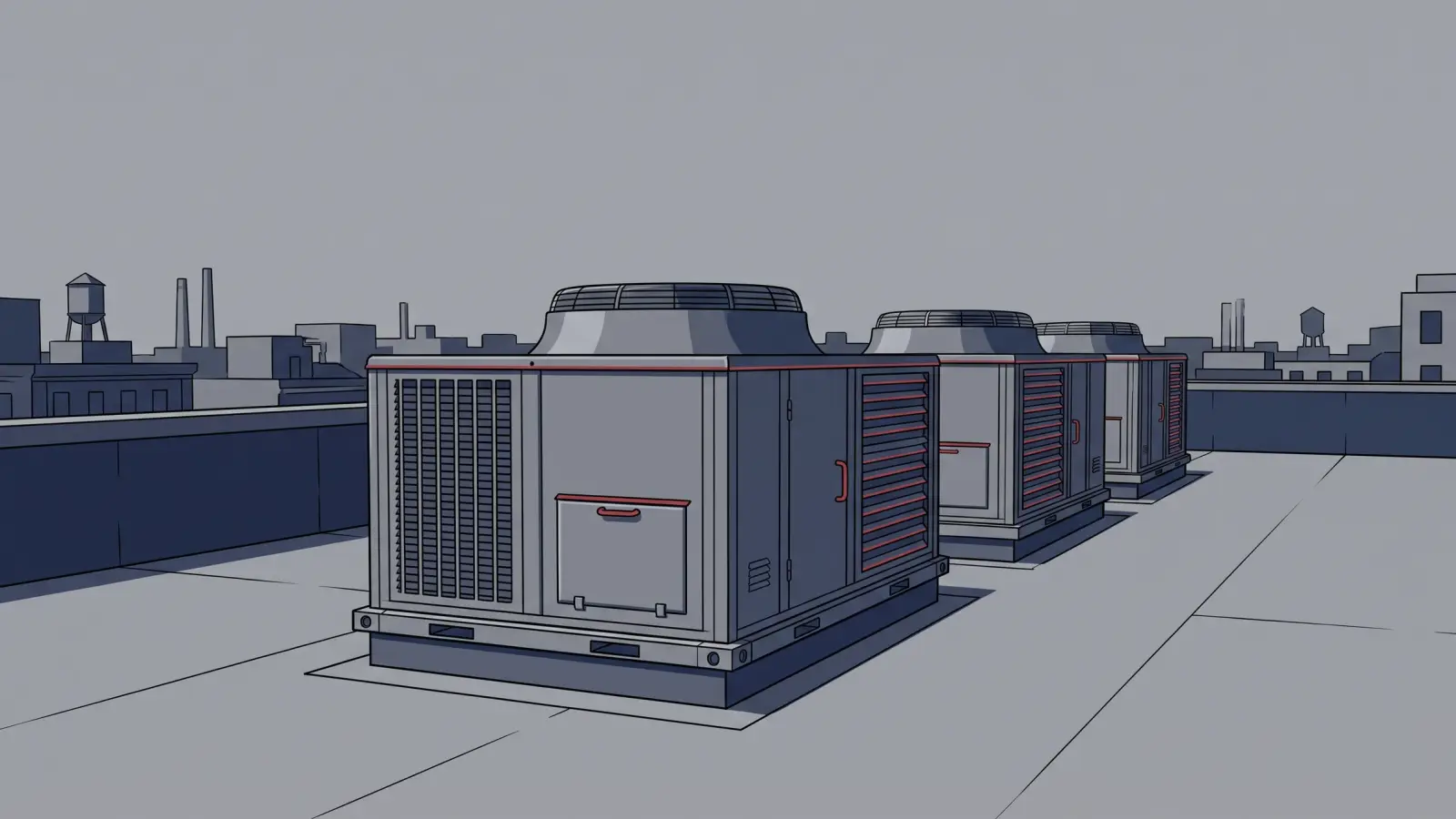
The rooftop quit, and nobody saw it coming
It starts as a phone call. The east end of the second floor is warm, somebody has propped the stairwell door open, and the tenant who always complains first has already complained. Up on the roof one of the units is sitting quiet, with nothing on it that explains itself to anyone standing in front of it. Or it is running and running and the space is still not coming down. Either way, nobody on site has a name for what went wrong. There is a rooftop not doing what it did last week, and a building getting warmer while somebody works out who to call.
What was happening beforehand did have a name, and it had been happening for months. The unit was starting, running a minute or two, and shutting off. A few minutes later, again. From inside the building that pattern is close to invisible: the space stays broadly conditioned and the swings get put down to the weather. But the compressor pays for every one of those starts, and keeps paying, until the morning it does not start at all.
So the sequence runs backward from the way it gets reported. The failure is what everyone sees; the short cycling is what a technician finds afterward, on a unit already down. It is also exactly the kind of thing a routine preventive maintenance check would have caught months earlier, while it was still a small repair, because a unit that is short cycling is a compressor fault that has not finished yet. On equipment somebody looks at on a schedule, it does not get the chance to finish.
What short cycling actually is, and the number that defines it
Every technician has an opinion about what counts as too many starts. The manufacturers settled it in their own control logic, and that is where the useful definition lives.
Trane's ReliaTel refrigeration module, the primary control on Precedent and Voyager packaged equipment, enforces a floor. The Voyager III literature lists the Anti Short Cycle Timer as a standard function that "provides a three minute minimum 'ON' time and a three minute minimum 'OFF' time for compressors," and it names the reason: it "enhances compressor reliability by ensuring proper oil return" 4. The ReliaTel user guide states the same floor as a plain operating note: "the compressors are controlled to a minimum run time of 3 minutes, and once shut off will not start again for 3 minutes" 5.
That converts an argument into a measurement. On a ReliaTel-controlled unit, a compressor cannot legitimately run for less than three minutes or restart inside three minutes. So if you stand on the roof with a watch and count ninety seconds, you are not looking at a control cycling frequently. You are looking at something interrupting the circuit: a safety switch opening, a contactor dropping out, a control input going away. The control itself is not permitted to do what you just watched it do.
Cycle length is the diagnostic fork, and it splits cleanly:
- Cycles measured in seconds point at a safety switch or a control fault. Something is opening the circuit and the unit is restarting as soon as it is allowed to.
- Cycles measured in minutes, at or just above the control's own minimum, point somewhere else entirely: equipment materially oversized for the load it now serves, or a space sensor in the wrong place reading a condition the occupants are not in.
Those two findings lead to completely different conversations, and they cost completely different amounts. Timing the cycle before touching anything is the single highest-value thing anyone does on this call.
Why it damages the compressor. Field discourse in the trade is consistent on the mechanism: far higher current draw and heat build-up occur during starting than during steady running, so the compressor absorbs a disproportionate cost from every additional start 3. Trane's stated rationale for the three-minute floor points at the same physics from the other direction: a compressor that does not run long enough does not return its oil 4. Run it short enough, often enough, and the failure is not a question of whether.
What this looks like across equipment lines
Monzo services rooftop equipment from a dozen manufacturers, and their controls disagree in ways that matter on a diagnostic. None of the differences below make one brand better than another. They change what you should be looking at.
Trane. The RTRM "provides compressor anti-short cycle timing functions through minimum 'Off' and 'On' timing to increase reliability, performance and to maximize unit efficiency" 1. On high pressure, Trane counts to four: "if four consecutive open conditions occur during an active call for cooling, the compressor will be locked out, a diagnostic communicated to ICS, if applicable, and a manual reset required to restart the compressor," and on dual-compressor units only the affected circuit locks out 1. The service manual adds the same counting on the contactor circuit. With RTRM version 4.0 or greater, "CC1, CC2, or CC3 circuit must open on 3 consecutive cycles. On the 4th trip, the unit will lockout" 2. The minimum timings themselves are three minutes on and three minutes off.
That counting is worth knowing and worth not overreading, because it does not announce itself as a count. What the control presents on the roof is a circuit trip, and the work begins there: finding out what opened the circuit, not how many times it has opened before.
One Trane detail reads like a differentiator in the literature and is not one. Trane documents a Low Ambient Start Timer that "bypasses low pressure control when a compressor starts, eliminating nuisance compressor lockouts" 4. But bypassing the low-pressure control at start-up is standard across the equipment lines and always has been. Trane simply names it. The useful consequence is brand-independent: the nuisance low-pressure trip at start-up is already designed out, so a low-pressure trip on a cold morning is not that nuisance and is worth chasing.
York. The SunPremier control carries its own anti-short-cycle timer state, which produces one of the most common false diagnoses on this call 6. A unit sitting inside that timer is not faulted and reports nothing: the fan runs and the compressor does not. From the ground that is indistinguishable from a dead unit, and it gets called in as one.
York also counts differently on high pressure. Its compressors are "locked out due to high pressure unload" when the "HP switch has tripped three times," carried as a critical lockout, with stated causes of dirty condenser coils, condenser fan failure, or overcharge 6. Three on York, four on Trane, and the honest use of that difference is narrow. It is not a way to read a fault history and judge how much margin is left before a lockout, because a trip is a trip. One of them already means something failed and needs attention now. Nobody working a roof is counting toward a threshold.
Carrier. Here the detail comes from field reports rather than from published literature, and it is worth flagging as such. Technicians have documented dual scroll compressors on a packaged Carrier unit cycling every five to ten seconds, with circuits cutting out near 650 psi and suction pulled down to 250 psi before the high-pressure switch opened 7. Cycles that short are far below any control's permitted minimum, which is the tell: this is a refrigeration-side fault presenting as a control symptom.
That pattern is representative of what actually turns up, and it usually has a specific shape: a fault on the first circuit is what drives the second one to trip and lock out. So a two-circuit unit cycling this fast is one investigation rather than two. Find what is wrong on the circuit that failed first, and the second circuit's lockout generally explains itself.
The diagnostic path
In the order it actually pays to work, which is not always the order these calls follow.
- Time the cycle before anything else. Seconds and minutes lead to different investigations, and the distinction is free to make 3. Compare what you measure against the unit's own documented minimum. On ReliaTel-controlled Trane equipment that is three minutes on and three minutes off 45. Faster than the floor means something is interrupting the circuit.
- Confirm whether an anti-short-cycle timer is simply active. A unit inside its timer is not faulted, and treating it as faulted is how a straightforward call turns into a parts order 6.
- Pull the fault history rather than reading the unit in front of you. Lockouts reset, so the unit's present state understates what has been happening. Every trip in that history is worth working, and that is as true of the first one as of the third 126.
- Check the pressure switches electrically, not only by reading pressures. A sticking or failed switch produces short cycling with nothing mechanically wrong on the refrigeration side 3.
- Then work the refrigeration side: condenser coil condition, every condenser fan turning, and charge against the unit's stated method. York names dirty condenser coils first among its own stated causes, ahead of charge 6.
- Only for the long-cycle case, check thermostat or space sensor location and differential, and establish what the load on that unit actually is now versus what it was when the unit was selected.
The order matters because steps 1 through 4 are diagnostic labour and step 5 is often where the work is, but step 6 is the only one that can end in a capital request. Getting to step 6 without having done 1 through 5 is how buildings replace equipment that did not need replacing.
Not sure which of your rooftops is doing this? A free site evaluation maps the roof and gives you the static condition of every unit on it, at no charge. Call (925) 536-0535.
Repair or replace
Almost always repair, and on this fault the repair is usually somewhere else. What short cycling calls for is the other repairs: a pressure switch, a contactor, a control input, a coil cleaning, or a refrigerant correction. Short cycling is the symptom that leads to those findings rather than a finding of its own, and it is not by itself a reason to touch the equipment as a whole.
Replacement is a separate conversation with separate triggers, and short cycling is not one of them. It comes down to age and size. Past roughly fifteen years, replacement becomes a legitimate question on its own terms. And a unit materially oversized for a load that has changed — tenants left, floors got reconfigured, lighting got replaced, a server room moved out — satisfies quickly and cycles regardless of how healthy every component is. The rooftop correctly selected in 2009 may be substantially oversized for what that space does now. That is a right-sizing discussion rather than a repair decision, and it is worth having deliberately rather than discovering after a compressor changeout that the replacement cycles the same way.
If you are being told to replace a unit, establish the root cause first. A replacement installed over an unresolved fault reproduces the fault, which is the most expensive sequence available on this call.
One rule of thumb is worth naming, because it is common and it is not ours. Some technicians are taught "eight for eight": if the repair runs $800 or more and the unit is more than eight years old, replace it. That arithmetic asks nothing about the condition of the equipment in front of it. There are rooftops still running at forty years because somebody looked after them. Condition is the question, not the age and the invoice: take care of a unit over time and it takes care of you.
Any figures discussed in that conversation should be treated as directional until the unit and the load have both been surveyed.
What a maintenance program catches first
Short cycling is a compressor-life problem wearing a comfort problem's clothing, and that is precisely why it survives so long in buildings that only respond to complaints. Nobody reports it. The space is broadly conditioned, the swings get attributed to the weather, and the fault runs until a compressor fails on a hot afternoon.
Two things catch it early, and both belong to a program rather than to a service call. Trending run times surfaces a unit whose cycle count has climbed, before anyone notices anything in the space. And reading fault histories on a schedule catches trip counters at two and three, while the fix is still a switch.
Related: what a preventive maintenance program catches first
Working in the Bay Area
Related: when the economizer damper is the reason the unit is cycling Related: condensate faults on commercial rooftop units
Monzo HVAC has been servicing commercial and industrial rooftop equipment across the Bay Area for thirty years, on mixed fleets where a single roof carries three manufacturers and two generations of control. That is the ordinary case here, not the exception, and it is the reason the differences above are not trivia: a technician who reads every unit as though it behaves like the last one will misread half a roof.
If a unit at your facility starts and stops more than it runs, call (925) 536-0535 and ask for a free site evaluation.
One visit, no charge. We map the roof, check belt and filter condition and sizes, assess the static condition of every component, and where we can, bump-test each unit to confirm it starts and runs. You walk away with the pain points and the glaring gaps in your current program. On a roof where something is cycling, that is usually enough to tell you which unit is the problem and whether it is a switch, a coil or a sizing question.
If you already know what you have and want numbers rather than a survey — refrigerant pressures and temperatures, amp draws, cleanings — that is a comprehensive maintenance visit, and we scope it to a budget you set.
Service: commercial rooftop unit service and diagnostics
Frequently asked questions
What is considered short cycling on an AC unit?
On commercial rooftop equipment, the manufacturer's own control sets the floor. Trane's ReliaTel-controlled units hold a three minute minimum run time and a three minute minimum off time 45. Cycles shorter than that are not frequent cycling; they are a circuit being interrupted by a safety device or a control fault.
What should I do if a rooftop unit is short cycling?
Time the cycle and pull the fault history before anything else, and do both before any part is ordered. Cycles in seconds indicate a switch or control problem; cycles at the control's minimum indicate oversizing or a sensor in the wrong location. The two findings lead to completely different work.
Is short cycling actually damaging the compressor?
The unit will not start at all. Is that the same fault?
Why did it fail on the hottest day of the year?
Because that is when the trip counter finishes. Repeated high-pressure trips accumulate through the season, and the lockout arrives on the day ambient and load peak together. The cycling was visible for weeks; the lockout is simply where it became unavoidable.
Sources
- 1Trane, Packaged Rooftop Air Conditioners Precedent — Heat Pump 3 to 10 Tons — 60 Hz, Installation, Operation, and Maintenance, RT-SVX23R-EN, September 2022 source ↗
- 2Trane, Service and Diagnostic Support Manual — ReliaTel Microprocessor Controls, RT-SVD03N-EN, August 2022 source ↗
- 3HVAC-Talk, "Short Cycling: Explained" source ↗
- 4Trane, Voyager III Rooftop Units Cooling-only, RT-PRC022J-E4, 08/2014 source ↗
- 5Trane, ReliaTel Microprocessor control User guide, CNT-SVX15D-E4, November 2011 source ↗
- 6YORK, SunPremier 25-80 Ton Rooftop Units R-410A Start-Up and Operation Guide — Faults, 2023-12-21 source ↗
- 7HVAC-Talk, "Carrier RTU short cycling" source ↗