
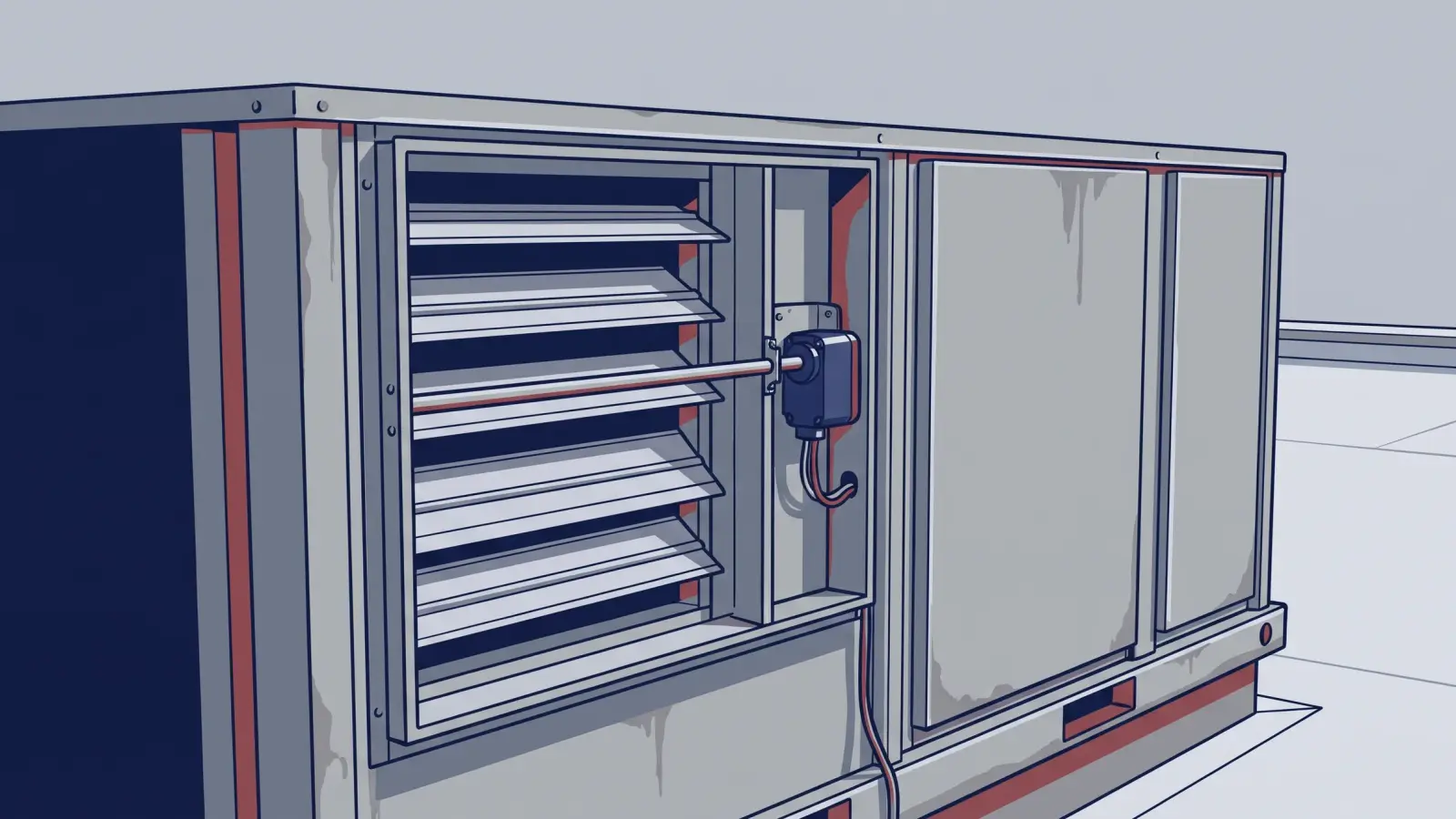
Cold all winter, and the gas use went up
The complaints start in November and they are always the same: cold drafts near the perimeter, the heat running more or less continuously, and a building that never quite gets comfortable on a cold morning. Then the gas consumption comes in higher than the previous year with no change in occupancy, no change in schedule, and no change in setpoints.
Those two facts belong together. A rooftop unit that is pulling in far more outdoor air than it should will produce exactly this pair of symptoms, and it will produce them without setting off anything anyone is watching. The heating section is doing its job. It is just fighting a stream of unconditioned outside air that nobody asked for.
What is actually happening
The economizer damper is stuck open, or failing open, and the unit is heating outdoor air.
This is the mirror image of an economizer that never opens, and it is the more expensive of the two directions. The unit is not merely failing to save energy. It is actively importing load.
The scale is easier to grasp on the cooling side, where it has been modelled. In Heinemeier's ACEEE work, a simulated Bakersfield building with an economizer stuck fully open saw summer peak load rise by 84 percent 3. That figure is a cooling-season model, not a winter measurement, and it should be read as an order of magnitude rather than a number to quote at a client. But the direction it establishes is the point: an economizer failed open is not a small inefficiency.
And energy is only half the exposure. The economizer is also where the building's fresh ventilation air comes from, so one that was never set up correctly is an indoor air quality problem as well as an operating cost. Improper setup contributes to the occupant complaints that get filed under sick building syndrome. A gas bill will never show that half.
Four different faults produce the same symptom, and they are nowhere near equally likely:
- A sensor or installation fault — the largest contributor by a wide margin. A failed sensor, a sensor in the wrong place, or an economizer never commissioned correctly drives the damper to positions nobody asked for, and not always to one held wide open; erratic opening and closing is the same fault wearing different clothes.
- A configuration error — the minimum damper position is set far higher than the ventilation requirement, so the damper is open exactly as commanded and there is no hardware fault at all.
- A schedule fault — the unit is not seeing its unoccupied period, and is holding a ventilation position through the night.
- A mechanical failure — blades bound, linkage slipped, actuator lost its return.
That order is close to the reverse of the order these calls get worked: sensors and installation are where the fault lives, bound blades are where technicians start looking. And the configuration error is the trap: from inside a cold building, a mis-entered minimum position is indistinguishable from a broken damper, and nobody finds it by looking at the hardware.
What this looks like across equipment lines
Monzo services rooftop equipment from a dozen manufacturers. On this fault the three below behave differently enough that knowing which one you are standing in front of changes the first thing you do.
York. The SunPremier control names this failure directly rather than leaving it to inference: fault 101, "Economizer economizing when it must not", described as "Economizer damper did not close as commanded. Damper stuck open" 2. A commanded-versus-actual mismatch is already recorded, which means the diagnosis can begin with the fault history rather than with a ladder.
Lennox. The damper minimum position is a configured value with a range from 0 percent open, meaning dampers closed, to 100 percent, meaning dampers fully open 1. That range is the whole story: a minimum position entered as a large percentage holds the dampers wide open permanently, with every component working correctly. Lennox also holds dampers closed in the unoccupied column across its control modes 1, so a unit that never sees unoccupied never closes.
Lennox is where the range is documented plainly, not where the exposure is unusual. Essentially every current line can be configured into this state, and the result is not always a damper pinned open; erratic opening and closing comes from the same place.
Trane, and a generational split that matters more than the brand does. The Precedent literature describes an Economizer Control Actuator that "is spring returned to the closed position any time that power is lost to the unit," delivers up to 25 inch pounds of torque, and runs on 24 Vac 4, with minimum position set by "adjusting the minimum position potentiometer located on the unit economizer actuator" 4. That is a physical pot rather than a software parameter, with its own failure surface: a pot can be knocked, corrode, or be adjusted by someone who never wrote down the original value.
All of that is accurate, and all of it is now history. The ECA is no longer used. California's energy code requirements for fault detection and diagnostics retired it, and the potentiometer went with it. Current equipment across the major lines runs a digital controller driving a modulating damper motor, which moves the adjustment into software and the fault surface with it: a value in a controller, not a pot on an actuator.
So the first question on arrival is which generation is on the roof. A pot at the actuator is legacy installed base and still turns up, but it is not where minimum position lives on recent equipment, and not what a unit installed under current code will have at all.
The diagnostic path
- Read the fault history before climbing anything. A commanded-versus-actual mismatch may already be recorded, as York fault 101 2.
- Check the sensors, and how they were installed. This is where the fault most often is: a failed sensor, a sensor in the wrong place, or an economizer never commissioned properly. Erratic damper movement points here well before it points at the damper.
- Read the configured minimum position, and write down what you found. On current equipment that is a value in the controller; on legacy Trane units it is the potentiometer at the actuator 14. This is the step most often skipped, and it is the one that catches the failure with no broken part. A minimum position set for ventilation and a minimum position set wide open look identical from the occupied space.
- On legacy spring-return actuators, cut power and watch the damper. It should shut on its own 4; if it stays open with no power on it, the fault is mechanical: binding, a slipped linkage, or a failed spring. The test does not transfer to a modulating damper motor on a digital controller.
- Inspect blades and linkage for binding, and the actuator for loss of return. Only now.
- Confirm the unit is actually seeing its unoccupied period, and that the damper closes when it does 1.
Steps 1 through 3 cost minutes and resolve most of these calls. Step 5 is where technicians usually start.
Repair or replace
Repair, in nearly all cases. An actuator, a linkage, or a configuration correction covers this fault, and none of them implicate the unit.
Replacement of the economizer assembly enters the conversation only where the damper hardware itself is corroded past adjustment, a condition assessment made on the roof rather than a default recommendation. Where a single roof carries several economizers in that condition, the sensible question is whether to address them as a fleet rather than one service call at a time. Any figures raised in that conversation are directional until the assemblies have been surveyed.
What a maintenance program catches first
This fault does generate complaints, which means it usually does get fixed. It gets fixed late, typically after a full heating season of importing cold air, because the complaint reads as a comfort problem and gets handled as one.
It does not have to be late. Under a competent maintenance program this fault gets caught before the customer feels anything at all, and the three checks that catch it belong in a scope rather than in a service call: verify the economizer sensors and the quality of their installation, read and record the configured minimum position on every economizer, and verify actual damper closure on the unoccupied cycle rather than in occupied mode. A damper stroked from full open to full closed at midday proves nothing about what it does at two in the morning. Our Health, Performance & Safety Plan includes an economizer check and an evaluation of indoor air quality, so both halves of this fault, the energy and the fresh air, can be on the record.
Related: what a preventive maintenance program catches first
Working in the Bay Area
Title 24 specifies which economizer control types are allowable on commercial rooftop equipment 3. That makes a damper held open by a configuration value rather than by control logic a compliance question as well as an operating cost: the unit is not delivering the control function the code contemplated, even though nothing on it has failed.
Monzo HVAC has serviced Bay Area commercial rooftop equipment for thirty years, on roofs that routinely carry two or three manufacturers and more than one generation of economizer control. If your building is cold on winter mornings and gas use has moved without anything else moving, call Monzo HVAC at (925) 536-0535 to discuss your commercial HVAC service needs or arrange an evaluation.
Ask about our Health, Performance & Safety Plan: a performance baseline for every unit, operating data logged at every maintenance visit, and the safety checks that help identify developing issues early, scoped to a budget you set.
Service: commercial HVAC maintenance programs
Frequently asked questions
What happens if the damper is closed?
A fully closed economizer damper delivers no outdoor air, so ventilation drops below what the space requires and no free cooling is available on mild days. It is the opposite fault, and on most controls it is the less costly of the two, but it is a ventilation compliance problem.
How do you get a stuck damper unstuck?
Do not force it. Determine first whether it is bound or simply commanded open, because forcing a damper that was never commanded closed tells you nothing. On spring-return actuators, removing power should close it 4. If it does not, the linkage and blades are the problem.
Can a stuck economizer really change gas use that much?
The modelled cooling-season case is large: an 84 percent increase in summer peak load in one simulated building 3. Heating-season behaviour has not been measured the same way, so treat any figure as directional. The mechanism is not in doubt: unconditioned outdoor air is being heated.
Why did nobody catch this last winter?
Because it presents as a comfort complaint, and comfort complaints get answered with setpoint changes. Nothing on the unit faults, the heat runs, and the building stays broadly usable. The cost shows up in gas consumption, which is reviewed on a different schedule than complaints are.
Sources
- 1Lennox, ECONOMIZERS — Installation Instructions 507231-04, 4/2024 source ↗
- 2YORK, SunPremier 25-80 Ton Rooftop Units R-410A Start-Up and Operation Guide — Faults, 2023-12-21 source ↗
- 3Heinemeier, K., "Free Cooling: At What Cost?", ACEEE Summer Study on Energy Efficiency in Buildings, 2014, University of California, Davis source ↗
- 4Trane, Packaged Rooftop Air Conditioners Precedent — Heat Pump 3 to 10 Tons — 60 Hz, Installation, Operation, and Maintenance, RT-SVX23R-EN, September 2022 source ↗